What is quantum computing?
Quantum computing is a new way of processing information that uses the strange but very real rules of quantum physics. This plain-English guide explains the core ideas of quantum computing — qubits, superposition, entanglement and interference — how a quantum computer actually runs a program, what quantum computers are good for, and why they are so hard to build. No physics degree required.
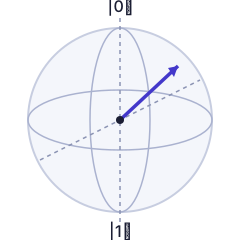
Classical computers vs. quantum computers
Every phone, laptop and server today is a classical computer. It stores information as bits, and each bit is either a 0 or a 1. Everything those machines do — this web page, your photos, your spreadsheets — is ultimately long strings of those 0s and 1s being shuffled and combined by simple logic gates, billions of times per second.
A quantum computer stores information as qubits, short for quantum bits. The crucial difference is that a qubit does not have to be only 0 or only 1. It can hold a blend of both at the same time, and groups of qubits can be linked together in ways that have no classical equivalent. That single change in the rules is what gives quantum computers their unusual power for a specific set of problems. The trade-off is that qubits are fragile and probabilistic, which makes quantum computers much harder to build and operate.
The core ideas behind quantum computing
Three or four ideas do almost all of the heavy lifting. You do not need the underlying mathematics to understand them, just a willingness to accept that the very small behaves differently from the everyday world.
Superposition
A coin on a table is either heads or tails. But while it is spinning in the air, it is in a sense a mixture of both until it lands. A qubit is like that spinning coin: through superposition, it can represent a combination of 0 and 1 simultaneously. Crucially, when you have many qubits in superposition, the number of combinations they can represent grows exponentially. Twenty qubits can represent over a million combinations at once; three hundred qubits could, in principle, represent more states than there are atoms in the observable universe. This is the raw material of quantum speedups.
Entanglement
Two qubits can be linked so that measuring one instantly tells you something about the other, no matter how they are arranged. Einstein famously called this "spooky action at a distance." Entanglement means qubits stop behaving like independent switches and start behaving like a single, coordinated system. This correlation is essential: without entanglement, a quantum computer would be little more than a collection of fancy coins, and the most important quantum algorithms simply would not work.
Interference
Because qubits behave like waves, the different possibilities a quantum computer is juggling can add together or cancel out, exactly like ripples meeting on the surface of a pond. A well-designed quantum algorithm choreographs this interference so that the paths leading to wrong answers cancel out, while the paths leading to the right answer reinforce. Steering interference toward the correct result is the real art of quantum programming.
Measurement
There is a catch. The moment you measure a qubit, its superposition collapses to a definite 0 or 1, and the rich blend of possibilities disappears. You only ever read out ordinary bits at the end. This is why quantum algorithms are designed so that, by the time you measure, interference has already concentrated the probability on the answer you want. Because measurement is probabilistic, quantum programs are often run many times to build up a confident result.
Quick mental model: a classical computer checks paths through a maze one at a time. A quantum computer can explore many paths at once and use interference to make the best path stand out. It is not magic, and it is not faster at everything — just at certain well-suited problems.
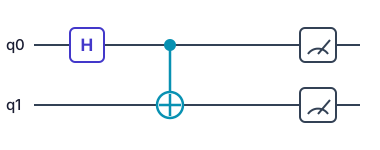
How a quantum computer actually runs a program
Writing a quantum program looks surprisingly familiar once you see it. You start with a set of qubits in a known state, usually all 0. You then apply a sequence of quantum gates — the quantum equivalent of the AND, OR and NOT gates inside a classical chip. A gate such as the Hadamard gate puts a qubit into superposition; a gate such as the controlled-NOT (CNOT) entangles two qubits. A particular ordered list of gates is called a quantum circuit.
After the circuit runs, you measure the qubits and read out classical bits. Because of the probabilistic nature of measurement, you typically run the same circuit hundreds or thousands of times and look at the distribution of results. Tools like IBM's free Qiskit framework let you build these circuits in Python and run them on simulators or on real quantum hardware over the cloud, which is why a curious beginner can experiment without owning any special equipment.
Types of qubits: how quantum computers are built
There is no single "quantum chip." Researchers are pursuing several competing hardware approaches, each with different strengths, and it is not yet clear which will win — or whether several will coexist.
Superconducting qubits
Tiny superconducting circuits cooled to near absolute zero, used by companies such as IBM and Google. They are fast and benefit from existing chip-fabrication know-how, but require elaborate refrigeration.
Trapped-ion qubits
Individual charged atoms held in place by electromagnetic fields and manipulated with lasers. They tend to be very stable and accurate, though operations can be slower.
Neutral-atom qubits
Neutral atoms arranged with light and controlled with lasers. This approach has attracted intense interest for its potential to scale, and it is directly relevant to recent University at Buffalo research on how quantum information can be preserved longer.
Photonic qubits
Particles of light used as qubits, attractive because photons interact weakly with their environment and can travel through optical fibers, which is useful for quantum networking.
Famous quantum algorithms
Shor's algorithm
In 1994, Peter Shor showed that a sufficiently large quantum computer could factor enormous numbers exponentially faster than known classical methods. Because much of today's internet security relies on the difficulty of factoring, Shor's algorithm is the reason governments and companies are already preparing "post-quantum" encryption.
Grover's algorithm
Grover's algorithm provides a quadratic speedup for searching an unsorted space of possibilities. It is less dramatic than Shor's exponential speedup, but it applies to a wide range of search and optimization-style problems, making it one of the most broadly useful quantum techniques.
What quantum computers are good for
- Chemistry & materials: simulating molecules and reactions to accelerate drug discovery, better batteries, and new materials — arguably quantum computing's most natural application.
- Optimization: finding efficient routes, schedules, and portfolios among astronomically many options in logistics, manufacturing and finance.
- Cryptography & security: both threatening some current encryption and enabling new quantum-safe methods.
- Machine learning: experimental approaches that may speed up certain pattern-finding tasks.
Notice what is not on the list: web browsing, word processing, gaming, or everyday apps. For those, classical computers are and will remain better. Quantum computers are specialized accelerators that will work alongside classical machines, not replace them.
Why quantum computers are hard to build
If quantum computers are so powerful, why isn't everyone using one? The answer is that qubits are extraordinarily delicate. Tiny vibrations, stray heat, or random electromagnetic noise can disturb a qubit and corrupt the computation — a problem called decoherence. To fight it, today's machines run in heavily shielded, often deeply cooled environments, and researchers use quantum error correction, which spreads the information of one reliable "logical" qubit across many physical qubits. Scaling up the number of stable, error-corrected qubits is the central challenge of the field, and it is exactly the kind of problem teams at the University at Buffalo and around the world are working on. Learn what is happening locally on our quantum computing in Buffalo page.
Common misconceptions about quantum computing
- "It tries every answer at once." Not quite. Superposition represents many possibilities, but measurement gives you only one. The skill is using interference so the right answer is the one most likely to appear.
- "It will replace my laptop." No. Quantum computers are specialized tools for specific problems, not faster general-purpose computers.
- "It's basically a really fast supercomputer." No. A quantum computer is a fundamentally different kind of machine; it offers speedups only for certain problem structures.
- "It already broke encryption." No. The hardware needed to run Shor's algorithm at scale does not exist yet, though preparation is wisely underway.
Best books to start learning quantum computing
Some links below are Amazon affiliate links. If you buy through them, this site may earn a small commission at no extra cost to you. Learn more.
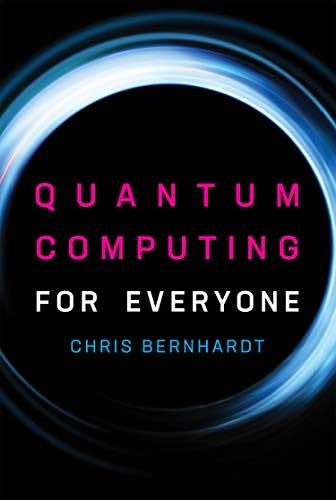 Beginner
Quantum Computing for Everyone
The clearest on-ramp for non-scientists. Builds real understanding using only high-school math.
Check price on Amazon (opens in a new tab) Beginner
Q Is for Quantum
A short, visual introduction that teaches genuine quantum reasoning with simple diagrams.
Check price on Amazon (opens in a new tab)Quantum computing FAQ
What is a qubit?
A qubit (quantum bit) is the basic unit of information in a quantum computer. Unlike a regular bit, which is either 0 or 1, a qubit can be in a combination of both states at once thanks to superposition, which lets quantum computers explore many possibilities simultaneously.
How is a quantum computer different from a regular computer?
Regular computers store information as bits that are strictly 0 or 1. Quantum computers use qubits that can be in superposition and can be entangled, which allows certain problems — like simulating molecules or searching huge spaces — to be solved far more efficiently. Quantum computers complement classical computers; they do not replace them.
What are quantum computers good for?
Promising applications include chemistry and materials simulation, optimization problems in logistics and finance, machine learning, and cryptography. Many uses are still experimental because today's machines are limited by error rates and qubit counts.
Do I need to be a physicist to learn quantum computing?
No. Beginner books like Quantum Computing for Everyone by Chris Bernhardt use only basic math, and free tools such as IBM Qiskit let you run simple quantum programs in a browser. Curiosity matters more than a physics degree.
Will quantum computers break encryption?
A large, error-corrected quantum computer could one day break some widely used public-key encryption using Shor's algorithm. That hardware does not exist yet, and the security community is already standardizing post-quantum cryptography to prepare.